
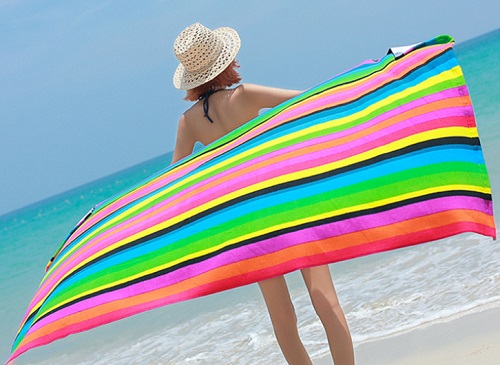
For an Italian brand developing printed beach towels, the key sourcing question is whether the finished fabric, artwork and presentation match the collection—not simply whether the factory can print a file. Use this guide to organise design development, sample approval and a specification-based production order in China.
Start with the Design Intent and Intended Use
Describe how the towel belongs in the collection: a lightweight travel accessory, a textured beach item, a gift or a resort-shop product. Send visual references with notes on what each represents, such as colour, scale or hand feel. A reference image alone should not be treated as a complete manufacturing specification.
Decide which details are essential and which can be adjusted. A large all-over illustration, a small woven label and a matching pouch create different production requirements. Keep artwork ownership clear and supply authorised designs. Do not copy another brand’s logo, licensed character or pattern simply because a similar towel is sold online.
Compare the available microfiber beach towel constructions before fixing artwork that depends on a particular surface. If you also consider cotton, use the cotton beach towel range for a separate material discussion rather than assuming the same print process applies.
Match the Printing Surface to the Artwork
Microfiber suede offers a fine, smooth face for detailed digital artwork. Waffle adds visible texture and a more substantial presentation, which may change how small elements appear. Brushed fabric has another surface character. Approve the artwork on the selected construction, not on a convenient substitute blank.
Na telefonie przesuń palcem w poziomie, aby przeczytać wszystkie kolumny.
| Design requirement | Candidate reference | Sample question |
|---|---|---|
| Fine lines and compact travel presentation | Suede, 200–350 gsm | Are detail and contrast acceptable at actual size? |
| Textured premium presentation | Waffle, 360–450 gsm | How does the texture affect the pattern? |
| Soft brushed appearance | Brushed, 230–350 gsm | Is the face/reverse balance right for the collection? |
These are reference ranges from the current range. Confirm actual composition, GSM, finished size and tolerances. Do not use GSM as a substitute for a physical feel assessment or promise a fixed drying time without testing.
Separate Digital Proof Approval from Physical Colour Approval
A digital proof establishes position, dimensions, orientation and artwork version. A printed sample establishes what the chosen fabric and process actually look and feel like. Approving a screen proof does not automatically mean you have approved physical colour, reverse appearance or wash performance.
Prepare a production-ready artwork brief
- State the finished towel dimensions and required print area.
- Identify bleed, borders, front/reverse orientation and label position.
- Use a clear colour reference and discuss achievable tolerances.
- Check small lettering and repeat patterns at full scale.
- Keep one revision-controlled approval file.
Digital sublimation is suitable for selected polyester-based printing surfaces; blend, construction and finishing still require evaluation. Do not substitute a different fabric after sample approval without reviewing the result. Reactive printing and other methods follow their own material requirements; compare options through our custom towel solutions.
Control Design Splits, MOQ and Sample Costs
Some suitable digitally printed products can start from 100 pieces per design. A collection with several colourways should be quoted by actual artwork and quantity, not by one combined total. Custom colours, labels and packs may have separate minimums. Mixed-design orders can cost more because production wastage changes.
Stock samples are free with freight paid by the buyer. A custom sample is charged according to material, size and print method, and the fee is creditable only when the bulk order value exceeds US$5,000. For digitally printed microfiber, use 7–10 days for samples and 20–35 days for bulk production as confirmed references from order placement and deposit receipt, with shipping additional. Agree on revision milestones before committing to a launch date.
Compare the approved sample against the written specification and note requested corrections clearly. “More premium” is not a measurable correction; identify whether you mean a different weight, softer finish, larger label or improved print definition. Keep the approved reference for production inspection and later reorders.
Review Italian Labels, Packaging and Origin Statements
Have the Italian-market label text checked against the actual fibre composition. “Microfiber” is not a complete fibre name and percentage declaration. The Wytyczne UE dotyczące etykietowania tekstyliów is the starting point; keep marketing descriptions separate from composition information.
For bags, bands and cartons, review CONAI’s environmental packaging labelling guidance i aktualne ramy UE dotyczące opakowań. Determine the requirements and responsible party for your exact packaging and route to market, including transitional dates. Do not automatically copy the recycling symbols from a pack made for another country.
A towel manufactured in China must not be presented as Italian-made simply because an Italian brand designed it. Origin claims and customs origin should be reviewed for the actual manufacturing operations. This guide does not determine a legal origin outcome or a tariff rate.
Discuss the EU product safety roles and documentation and relevant chemical restrictions with your importer and laboratory. A certification claim needs current, applicable evidence; a general supplier logo is not proof for a new collection.
Keep Production, Inspection and Delivery in One Plan
Check colour reference, print alignment, dimensions, GSM, hems, sewn labels and packed presentation before shipment. If a design relies on matching several components, include them in the approved packed sample. Agree in advance whether an independent inspection or laboratory testing is required and who handles the arrangements.
Request freight using actual carton dimensions and weights. Sea transport may suit planned collection orders; air transport may help a time-sensitive smaller batch, but availability and cost need a current quote. Agree on Incoterms, named place and import responsibilities. No supplier’s generic transit estimate should become a guaranteed retail launch date.
Favor Houseware Co., Ltd. is a custom towel manufacturer in Yiwu, China. We can review material, artwork, labels and packing with your team; our company page provides background. Send a design-led brief with measurable specifications so the quotation describes the collection you intend to sell, rather than an unspecified “custom towel”.
Pytania kupującego
Should we approve every colourway physically?
Discuss the risk and approval scope with the factory. A new background colour or fabric can change print appearance; one sample is not automatic approval of all variants.
Can we use the same artwork on cotton and microfiber?
The layout may be reusable, but the printing method and physical result need separate material-specific review.
Can you guarantee a perfect screen-to-fabric match?
No. Agree on a physical reference, achievable tolerances and an approval process instead.
Developing a Printed Towel Collection for Italy?
Send your design references, finished size, target GSM, quantity by colourway and packaging brief for a sample-based quotation. Favor Houseware can help you compare material and customisation options before confirming the order.
Poproś o wycenę