
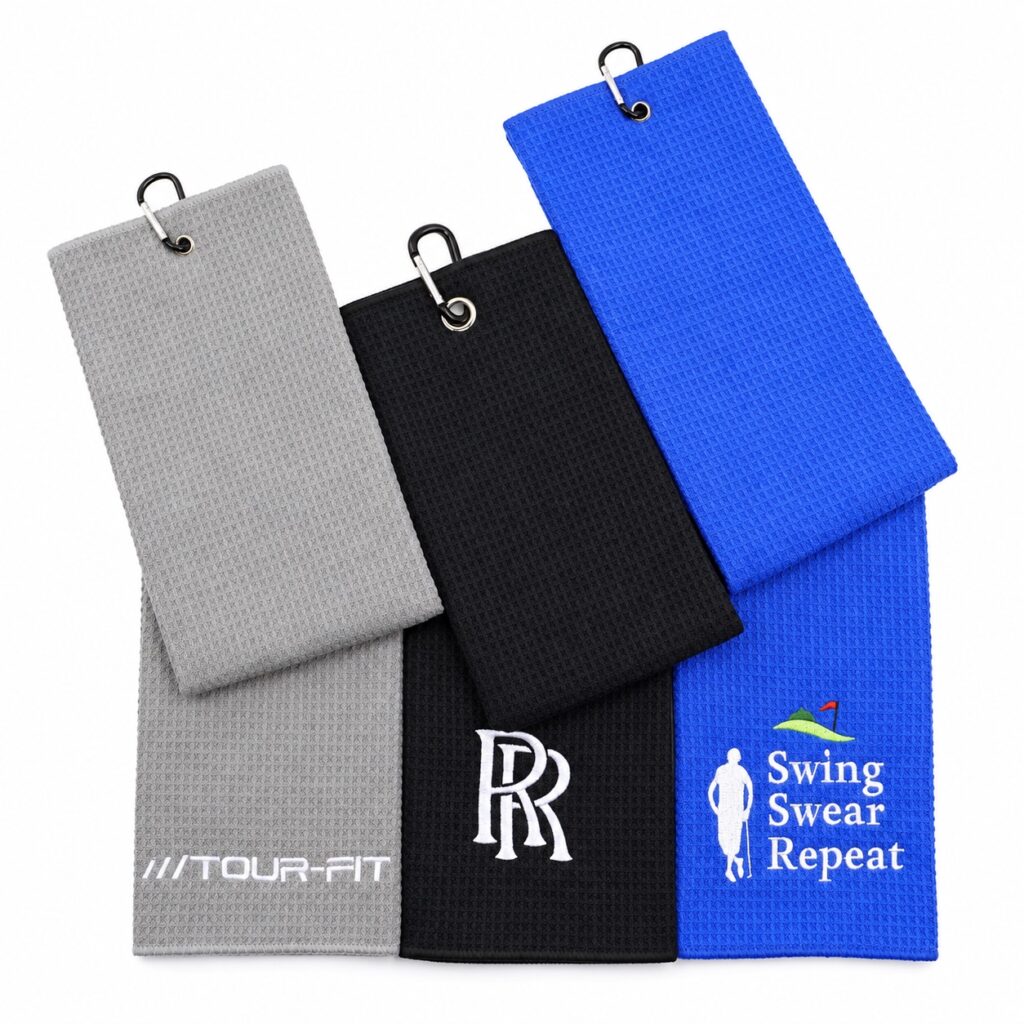
Microfiber and cotton are both excellent materials for golf towels, but the better choice depends on how the towel will be used. Microfiber waffle towels are often preferred for cleaning golf clubs, removing dirt, and drying quickly. Cotton towels offer a soft, traditional feel and are popular for embroidered club merchandise and premium golf gifts.
For golf brands, wholesalers, and tournament organizers, material selection also affects product weight, customization methods, minimum order quantities, and overall manufacturing costs.
So, should you choose a microfiber or cotton golf towel?
This guide compares their cleaning performance, absorbency, drying characteristics, fabric weight, customization options, and suitability for bulk orders.
1. What Is the Difference Between Microfiber and Cotton Golf Towels?
The main difference lies in their fiber composition and fabric construction.
Microfiber is typically made from very fine synthetic fibers, often polyester and polyamide. These fibers can be manufactured into smooth, plush, or textured surfaces.
Cotton is a natural cellulose fiber that is widely used in traditional towels because of its softness and ability to absorb water.
Both materials can be suitable for golf equipment cleaning, but they do not necessarily deliver the same user experience.
Microfiber vs. Cotton Golf Towels: Quick Comparison
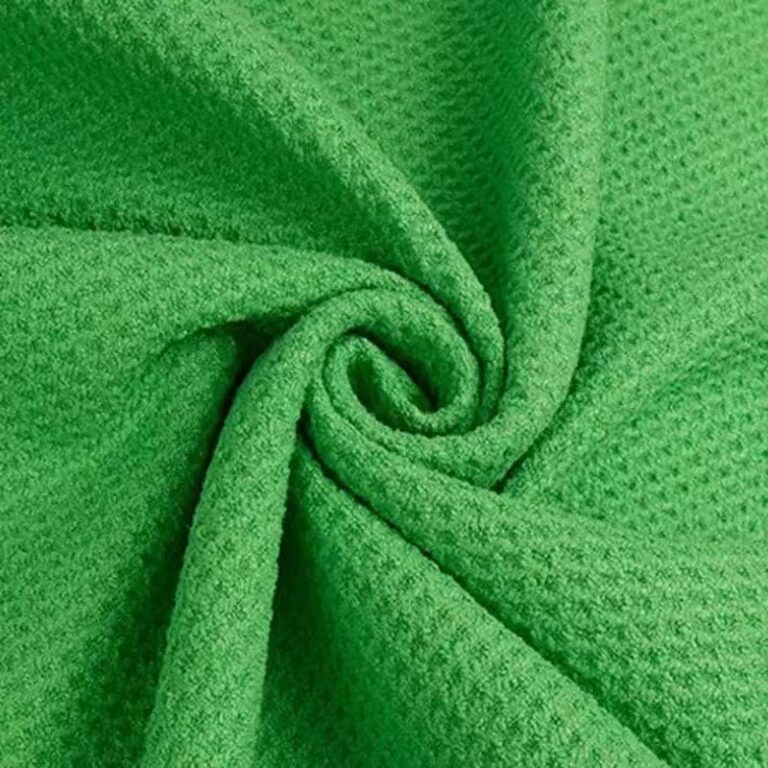
Microfiber Waffle
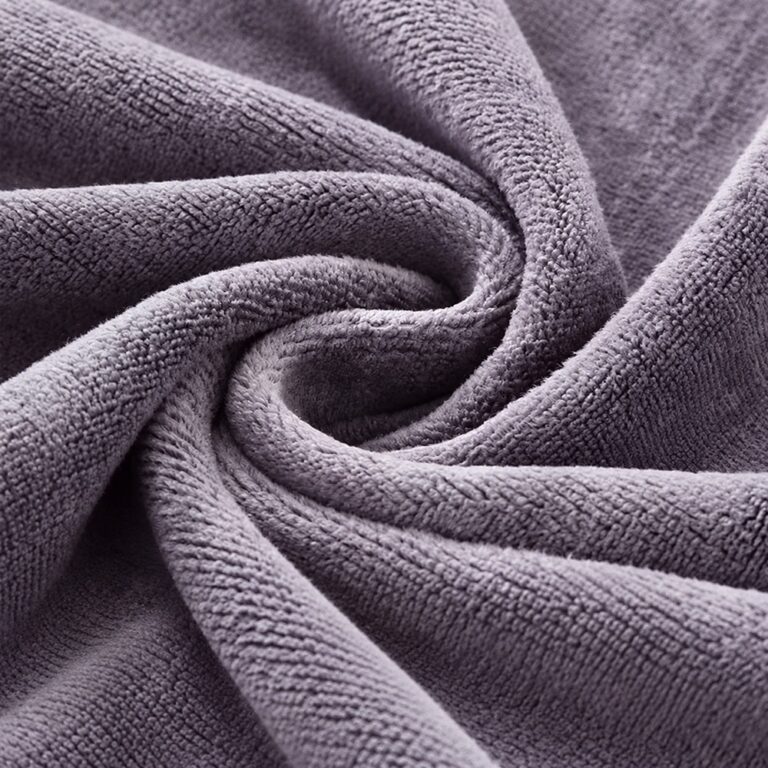
Microfiber Velour
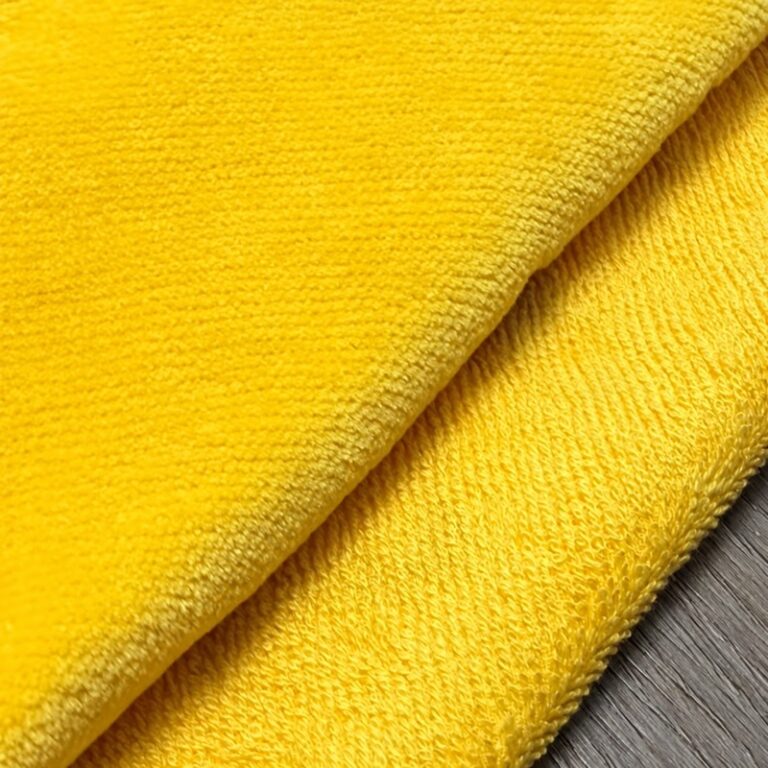
100% Cotton Velour
| Feature | Microfiber Golf Towel | Cotton Golf Towel |
|---|---|---|
| Fiber type | Fine synthetic fibers | Natural cotton fibers |
| Common surface | Waffle, velour, terry | Terry, velour |
| Feel | Smooth, plush, or textured | Soft and traditional |
| Club cleaning | Particularly useful in waffle construction | Good for general cleaning |
| Absorbency | Depends on fiber blend and construction | Naturally absorbent |
| Drying speed | Often faster under comparable conditions | May retain moisture longer |
| Embroidery | Available on suitable constructions | Often well suited |
| Full-color printing | Possible with compatible fabrics and processes | Possible with appropriate processes |
| Fabric weight | Available in multiple GSM options | Available in multiple GSM options |
| Best applications | Everyday golf accessories, promotions, printed designs | Golf clubs, embroidered merchandise, traditional gifts |
Quick recommendation: Choose microfiber waffle for a practical, fast-drying cleaning towel. Consider cotton velour when softness, traditional appearance, and embroidered branding are priorities.
However, buyers should compare actual samples rather than assuming all microfiber towels outperform all cotton towels.
2. Which Material Is Better for Cleaning Golf Clubs?
For removing dirt and grass from golf clubfaces, microfiber waffle towels are often a practical choice.
Their textured surface can help loosen and collect debris when used with a little water.
A cotton towel can also clean clubs effectively, particularly when used damp and combined with a suitable club-cleaning brush for stubborn dirt.
Why Is Waffle Weave Popular for Golf Towels?
Waffle weave features a repeating pattern of raised sections and recessed areas.
This creates a textured surface that can help lift soil from golf equipment.
The texture can be particularly useful for:
- Cleaning iron clubfaces
- Removing grass and light mud
- Wiping golf balls when cleaning is permitted
- Cleaning grips and equipment surfaces
The cleaning ability of a towel depends on more than fiber type. Fabric texture, moisture level, and how the towel is used are also important.
Can Cotton Golf Towels Clean Clubs Effectively?
Yes.
Cotton towels are suitable for general cleaning, wiping moisture, and drying golf equipment.
For everyday use, many golfers may find a cotton towel perfectly adequate.
However, buyers looking for a more textured cleaning surface may prefer microfiber waffle constructions.
Best choice for club cleaning: Microfiber waffle is a strong option, especially for golfers who frequently clean dirt from clubfaces.
3. Which Golf Towel Is More Absorbent: Microfiber or Cotton?
Both microfiber and cotton can absorb water, but their actual absorbency depends on fabric construction and finishing.
Cotton fibers naturally absorb moisture. Cotton towels with an appropriate pile structure can hold a substantial amount of water.
Microfiber fabrics use fine synthetic fibers and engineered fabric structures to attract, distribute, or retain moisture.
Some microfiber constructions provide excellent absorption and wicking behavior.
However, it would be inaccurate to claim that every microfiber towel absorbs more water than every cotton towel.
What Determines a Golf Towel's Absorbency?
Important factors include:
- Fiber composition
- Fabric weave or knitting construction
- Surface texture
- GSM and fabric thickness
- Finishing treatments
- Washing and previous use
For wholesale purchasing, absorbency should be measured using representative samples.
How Can Manufacturers Compare Absorbency?
One approach is to measure the amount of water a dry fabric specimen absorbs under a defined test procedure.
A useful calculation is:
Water Absorption Capacity = (Wet Sample Mass − Dry Sample Mass) ÷ Dry Sample Mass
The result can be expressed as grams of water absorbed per gram of dry fabric.
For meaningful comparisons, test samples should use the same procedure, conditioning, immersion or exposure time, and drainage method.
The result will depend on the specific procedure, so buyers should request the test conditions rather than comparing isolated numbers.
Buying advice: For golf towel sourcing, review both absorbency capacity and how easily the towel releases moisture during drying.
4. Do Microfiber Golf Towels Dry Faster Than Cotton?
Microfiber golf towels often dry faster than cotton towels of comparable construction and usage conditions.
This can make microfiber attractive for golfers who play frequently or encounter wet weather.
However, drying speed is influenced by more than fiber type.
Fabric weight, thickness, air circulation, temperature, humidity, and retained water content also affect how long a towel takes to dry.
Why Does Drying Speed Matter?
A towel that remains damp for an extended period may be less convenient to store or reuse.
Faster-drying towels can be useful for:
- Frequent rounds of golf
- Wet or humid conditions
- Travel and golf vacations
- Compact golf bag storage
- Golf accessories intended for everyday use
How Should Drying Performance Be Tested?
To compare microfiber and cotton fairly:
- Prepare fabric samples with documented dimensions and dry weights.
- Wash or condition the samples consistently.
- Wet each sample according to a defined procedure.
- Apply the same drainage or water-removal conditions.
- Dry the samples under the same temperature, humidity, and airflow.
- Record their weight at consistent time intervals.
- Compare the time required to reach a defined residual moisture level.
Standardized laundering can help improve test consistency.
ISO 6330:2021 describes domestic washing and drying procedures for textile testing, although it does not by itself establish a universal drying-time ranking for golf towel materials.
Best choice for quick drying: Microfiber is generally worth considering, but verify actual drying performance when it is an important product requirement.
5. What Is the Best GSM for Microfiber and Cotton Golf Towels?
GSM means grams per square meter. It is a measurement of fabric mass per unit area.
A higher GSM generally indicates more fabric mass for the same area, but it does not automatically mean better absorbency, cleaning ability, or quality.
We use approximately 350–400 GSM as a reference range for microfiber waffle golf towel projects. We confirm the available fabric weight when preparing your quote.
How Much Does a 40 × 60 cm Golf Towel Weigh?
A towel measuring 40 × 60 cm has a flat surface area of 0.24 square meters.
The theoretical fabric mass is:
Fabric Mass (g) = Area (m²) × GSM
| Fabric GSM | Calculated fabric mass at 40 × 60 cm |
|---|---|
| 300 GSM | 72 g |
| 350 GSM | 84 g |
| 375 GSM | 90 g |
| 400 GSM | 96 g |
| 450 GSM | 108 g |
| 500 GSM | 120 g |
These are mathematical calculations for one flat fabric panel, not measured weights of finished FAVOR golf towels. Edging, labels, attachments, construction differences, and manufacturing allowances affect final product weight.
For example, moving from 350 GSM to 400 GSM increases the theoretical fabric mass from 84 grams to 96 grams for the same flat dimensions.
That represents a 14.3% increase in fabric mass.
It does not necessarily represent a 14.3% increase in finished product price.
Is Higher GSM Always Better?
Not necessarily.
A heavier fabric may offer a different feel, but it may also increase weight, drying time, packing volume, and material cost.
Distributors should choose GSM based on the intended customer, price positioning, required cleaning performance, and sample results.
6. Which Material Is Better for Custom Logo Golf Towels?
Both microfiber and cotton golf towels can support custom branding.
The best decoration method depends on the fabric and artwork.
Embroidered Golf Towels
Embroidery creates a stitched logo with a textured appearance.
It can be suitable for traditional golf club emblems, small logos, and branded merchandise.
Cotton velour is often selected for embroidered golf towels because of its classic towel appearance.
Certain microfiber constructions can also support embroidery, provided the stitch density, backing, and fabric stability are appropriate.
Printed Golf Towels
Printing allows logos, patterns, and artwork to be applied to the towel surface.
For large designs with multiple colors, printing may be a more suitable option than embroidery.
However, the correct process depends on the fiber composition and the print method.
For example, polyester-rich microfiber may be suitable for certain heat-transfer or sublimation processes, while cotton may require different compatible printing techniques.
Logo Customization Comparison
| Customization requirement | Suggested approach |
|---|---|
| Small, simple club logo | Consider embroidery |
| Traditional stitched emblem | Consider embroidery |
| Large multi-color artwork | Evaluate printing |
| Full-surface graphic design | Evaluate compatible full-surface printing |
| Private-label retail branding | Combine suitable decoration with labels and packaging |
Embroidery is not automatically more expensive than printing.
Logo size, stitch count, color complexity, print coverage, setup costs, and production quantity determine the actual cost.
For an accurate recommendation, provide the manufacturer with your logo artwork and desired dimensions.
7. Are Microfiber Golf Towels Cheaper Than Cotton Golf Towels?
Neither material is always cheaper.
The price depends on the fiber, fabric structure, GSM, finished size, branding, order quantity, accessories, and packaging.
Rather than relying on a general material-price comparison, buyers should request quotations using equivalent specifications.
Example: FAVOR Microfiber Waffle Golf Towel Prices
For a 40 × 60 cm microfiber waffle golf towel, we provide the following indicative EXW reference prices in USD per piece:
| Order quantity | Reference EXW unit price |
|---|---|
| 100 pieces | $2.50–$3.00 |
| 500 pieces | $2.00–$2.50 |
| 1,000 pieces | $1.50–$2.00 |
Source: FAVOR factory-provided reference prices. Final quotation depends on GSM, logo size, embroidery or printing requirements, and other specifications.
Standard simple polybag and carton packaging is generally included. International freight is quoted separately.
These prices apply to the reference microfiber waffle specification. See our bulk golf towel pricing guide for the EXW terms and pricing details.
Why Does Bulk Quantity Matter?
Larger orders can improve production efficiency and reduce unit prices.
However, the right purchase quantity should also consider expected sales, storage costs, and available cash.
For detailed pricing analysis, read our guide to custom golf towel bulk pricing.
8. What Is the MOQ for Microfiber vs. Cotton Golf Towels?
Our minimum order quantity depends on the fabric and how we apply your design. For cotton golf towels, we offer three main customization options: embroidery, yarn-dyed jacquard and printing.
| Fabric and customization | Typical MOQ |
|---|---|
| Cotton terry or cotton velour with embroidery | Usually 500 pieces |
| Cotton terry or cotton velour with yarn-dyed jacquard | 2,000 pieces |
| Printed cotton velour | 1,000 pieces |
| Cotton waffle | Higher than microfiber waffle. Ask us to confirm the MOQ for your specification. |
| Microfiber waffle or microfiber velour | 100 pieces |
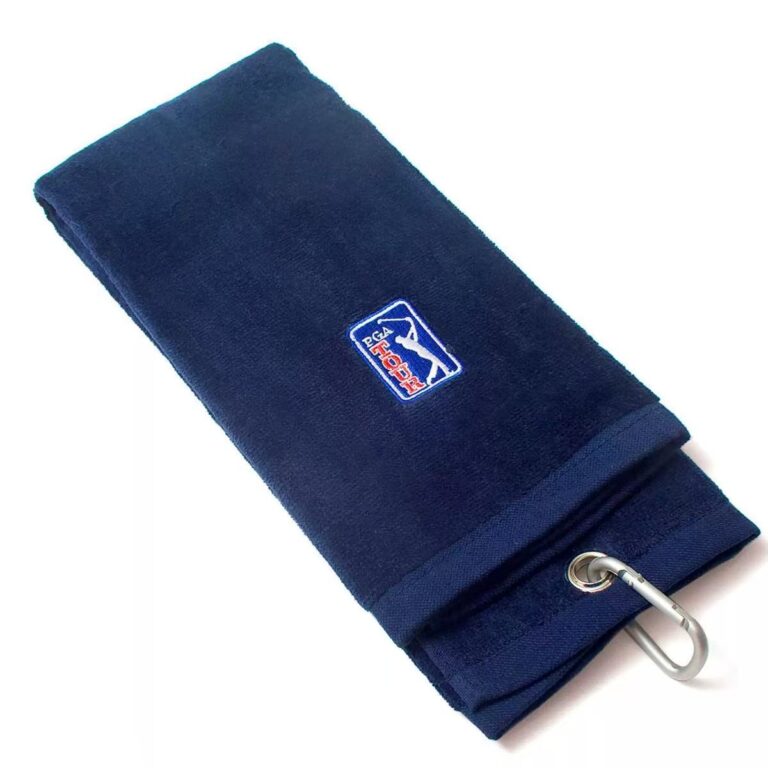
Embroidered Cotton
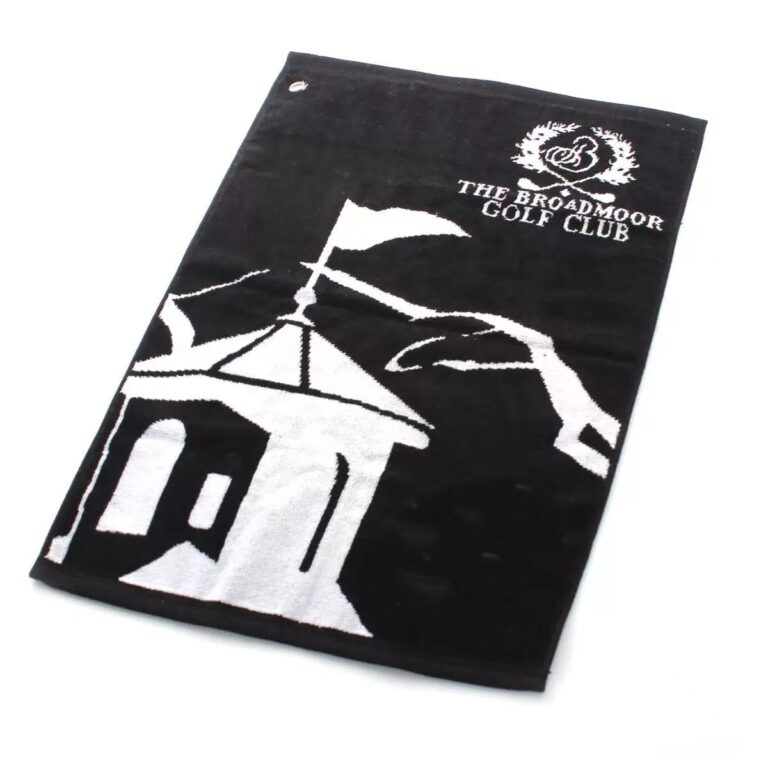
Yarn-Dyed Jacquard Cotton
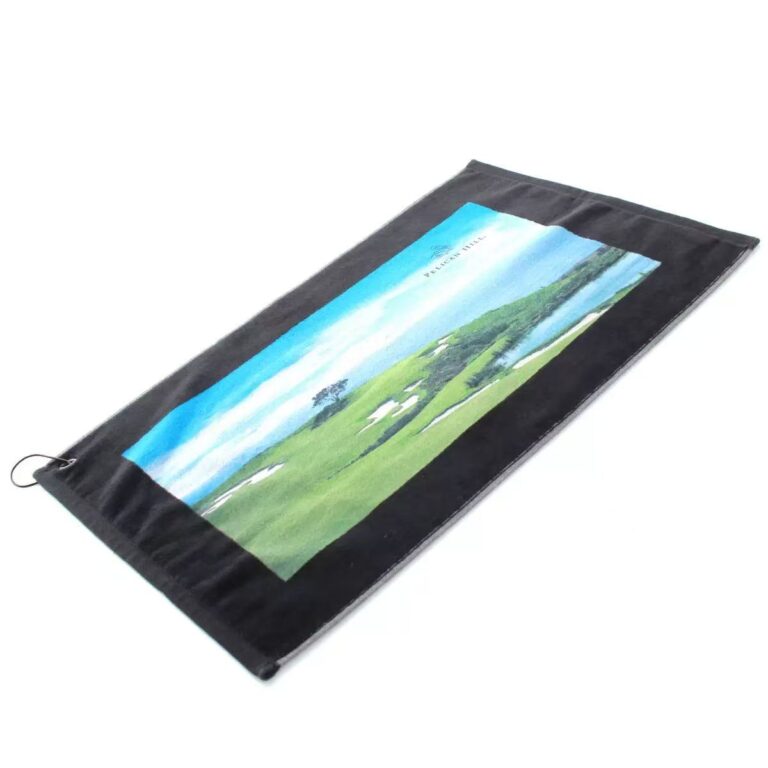
Printed Cotton Velour
Which Material Should You Choose for a 100-Piece Order?
We recommend microfiber waffle or microfiber velour for a 100-piece custom order. Choose waffle for a textured cleaning surface or velour for a soft pile. Send us your preferred fabric, artwork and quantities so we can confirm the MOQ for your design. Explore our custom golf towel options.
9. Which Golf Towel Is More Durable?
Both microfiber and cotton towels can provide good service life when properly manufactured and cared for.
Durability depends on fiber quality, fabric construction, stitching, laundering conditions, and frequency of use.
Important Durability Factors
Fabric construction
Poorly constructed towels may develop loose threads, distortion, or surface damage over time.
Colorfastness
Dyed and printed fabrics should maintain acceptable appearance after washing and normal use.
Dimensional stability
Towels should remain within agreed dimensional tolerances after the specified laundering process.
Logo durability
Embroidery or printing should remain acceptable after repeated washing.
How Can Wholesale Buyers Evaluate Durability?
Request samples and define practical tests for:
- Washing and drying
- Colorfastness
- Shrinkage
- Stitching quality
- Logo appearance
- Attachment security
- Surface pilling or linting
ISO 6330:2021 provides standardized domestic washing and drying procedures that can be used as part of textile testing.
The appropriate performance requirements and acceptance limits must still be agreed separately.
10. Which Material Should Different Golf Buyers Choose?
The right material often depends on the target customer and purchasing purpose.
Golf Accessories Brands
For brands developing practical, everyday golf accessories, microfiber waffle may be a strong starting option.
For brands positioning their products around a traditional soft towel feel, cotton velour may be worth exploring.
Golf Clubs and Pro Shops
Cotton velour towels with embroidered logos may suit traditional club merchandise.
Microfiber towels may work well for a more practical everyday accessory range.
Promotional Product Distributors
Microfiber velour and microfiber waffle can be considered for custom branded programs, depending on the artwork and order quantity.
Golf Tournament Organizers
Tournament buyers should consider budget, logo complexity, required delivery date, and packaging.
Both microfiber and cotton can work for event merchandise, provided the final specifications meet the project's needs.
Private-Label Retailers
Private-label buyers should test customer preferences before committing to a large assortment.
Product differentiation can come from color, fabric construction, attachments, packaging, and branding.
Material Selection by Customer Type
| Buyer type | Material worth considering | Main reason |
|---|---|---|
| Everyday golf accessory brand | Microfiber waffle | Textured cleaning surface |
| Premium club merchandise | Cotton velour | Traditional soft feel |
| Promotional distributor | Microfiber velour | Branding flexibility |
| Tournament organizer | Microfiber or cotton | Depends on project requirements |
| Private-label retailer | Both | Allows different product positioning |
| Small trial-order buyer | Microfiber options at FAVOR | Lower published MOQ |
These are product selection recommendations rather than verified sales rankings.
11. How to Choose the Right Golf Towel Manufacturer
Whether you choose microfiber or cotton, the manufacturer should provide clear specifications and representative samples.
Before placing a bulk order, request:
- Fabric composition and construction
- Finished towel dimensions
- GSM and unit weight
- Available colors
- Logo customization options
- Attachment options
- MOQ by material and design
- Sample availability and approval procedure
- Production lead time
- Packaging and shipping quotation
A manufacturer should also explain how it controls quality and handles repeat production orders.
If you are still evaluating suppliers, use our guide to choosing a golf towel manufacturer to plan the checks before ordering. For assortment and reorder planning, see our wholesale buying guide for distributors.
12. Frequently Asked Questions
Is microfiber better than cotton for golf towels?
Microfiber waffle is often a practical choice for club cleaning and quick drying, while cotton offers a softer, more traditional towel feel. Neither material is universally better. Choose according to the intended use and sample performance.
Which golf towel absorbs the most water?
Absorbency depends on fiber composition, weave, pile structure, fabric weight, and finishing. Both microfiber and cotton can be highly absorbent. Comparable laboratory testing is needed to establish which specific towel absorbs more water.
Are microfiber golf towels good for cleaning club grooves?
Yes. Textured microfiber waffle towels can help remove dirt and grass from clubfaces. For compacted debris, a suitable club-cleaning brush may also be needed.
Do cotton golf towels dry slower than microfiber?
Cotton towels often take longer to dry than comparable microfiber towels, but actual results depend on fabric thickness, water retention, temperature, humidity, and airflow.
What GSM is best for microfiber golf towels?
The best GSM depends on the desired weight, performance, and price. For our microfiber waffle golf towels, 350–400 GSM is a reference range. Ask us to confirm the available weight for your order. Buyers should compare actual samples.
Can you embroider microfiber golf towels?
Yes. Many microfiber fabrics can support embroidery, but the construction, stitch density, backing, and logo size need to be considered.
Is cotton better for embroidered golf towels?
Cotton velour can be an attractive choice for traditional embroidered towels, but appropriate microfiber constructions can also produce good embroidery results. The best decision depends on the artwork and sample finish.
Are microfiber golf towels cheaper than cotton?
Not necessarily. Prices depend on fabric specifications, size, production method, quantity, and customization. Request comparable quotations rather than assuming one material always costs less.
What is the MOQ for custom microfiber golf towels?
Our starting MOQ is 100 pieces for microfiber waffle and microfiber velour. The final minimum depends on the design and specifications.
How do I request a custom golf towel quotation?
Send your required quantity, towel size, fabric type, GSM, logo artwork, decoration method, packaging requirements, and delivery address to the manufacturer.
Conclusion: Microfiber or Cotton — Which Should You Choose?
Both microfiber and cotton golf towels have valuable advantages.
Microfiber waffle is a practical choice for golf club cleaning, quick-drying convenience, and everyday golf accessories.
Cotton velour is worth considering for buyers who prioritize a soft, traditional feel and premium embroidered presentation.
For wholesale and private-label orders, material selection should also consider fabric weight, branding requirements, minimum order quantities, and production costs.
Rather than choosing based only on material names, request samples and compare the finished products.
Looking for Custom Microfiber or Cotton Golf Towels?
We offer OEM and ODM golf towel manufacturing options for brands, clubs, importers, and promotional-product distributors.
Our product range includes microfiber waffle, microfiber velour, and cotton velour towels, with custom sizes, colors, logos, attachments, and packaging options.
Share your required material, towel dimensions, GSM, order quantity, and logo artwork to receive a quotation based on your specifications.